 People in computer vision and graphics deal with homogeneous coordinates on a very regular basis. They are actually a nice extension of standard three dimensional vectors and allow us to simplify various transforms and their computations. When I say “transformations”, I am talking about all those special effects on the screen, and the corresponding movements and scaling of various objects. But why do we need homogeneous coordinates to do all that? Why can’t we just move the objects around? Well, we can’t directly do that, not easily anyway! This will become clear soon. The concept of homogeneous coordinates is fundamental when we talk about cameras. In order to design our algorithms, we need to understand how the cameras are looking at the real world. This is in fact utilized heavily by game programmers as well. So what is it all about? Why is it so important? Continue reading “The Concept Of Homogeneous Coordinates”
What Is Maximum Likelihood Estimation?
 Let’s say you are trying to estimate the height of a group of people somewhere. If the group is small enough, you can just measure all of them and be done with it. But in real life, the groups are pretty large and you cannot measure each and every person. So we end up having a model which will estimate the height of a person. For example, if you are surveying a group of professional basketball players, you may have a model which will be centered around 6’7″ with a variance of a couple of inches. But how do we get this model in the first place? How do we know if this model is accurate enough to fit the entire group? Continue reading “What Is Maximum Likelihood Estimation?”
Using Hash Function In C++ For User-Defined Classes
 If you are a programmer, you must have heard the term “hash function”. In its most general form, a hash function projects a value from a set with many members to a value from a set with a fixed number of members. We basically convert the input into a different form by applying a transformation function. Hash functions map data of arbitrary length to data of a fixed length. The values returned by a hash function are called hash values. An interesting thing to note is that hash functions are not reversible. This means that you cannot recover the original data from hashed values. This property makes it one of the most useful data structures known to mankind. Hash functions are used extensively in internet security. In this post, we will talk about C++ STL and how to use hash functions with user defined classes. Continue reading “Using Hash Function In C++ For User-Defined Classes”
Understanding Camera Calibration
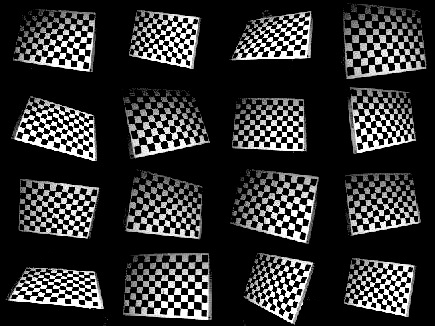 Cameras have been around for a long time now. When cameras were first introduced, they were expensive and you needed a good amount of money to own one. However, people then came up with pinhole cameras in the late 20th century. These cameras were inexpensive and they became a common occurrence in our everyday life. Unfortunately, as is the case with any trade off, this convenience comes at a price. These pinhole cameras have significant distortion! The good thing is that these distortions are constant and they can be corrected. This is where camera calibration comes into picture. So what is this all about? How can we deal with this distortion? Continue reading “Understanding Camera Calibration”
What Is Gamma Correction?
 Gamma correction is an integral part of all the digital imaging systems, but a lot of people don’t know about it! It is an essential part of all the imaging devices like cameras, camcorders, monitors, video players, etc. It basically defines the relationship between a pixel’s numerical value and its actual luminance. Now wait a minute, why would they be different? Isn’t a pixel’s numerical value supposed to be exactly the same as its luminance? Well, not really! Without gamma, shades captured by digital cameras wouldn’t appear as they did to our eyes. If we fully understand how gamma works, we can improve our exposure technique, along with making the most of image editing. So what is it all about? Why do we need gamma correction at all? Continue reading “What Is Gamma Correction?”
Recognizing Shapes Using Point Distribution Models
 In the field of computer vision, we often come across situations where we need to recognize the shapes of different objects. Not only that, we also need our machines to understand the shapes so that we can identify them even if we encounter them in different forms. Humans are really good at these things. We somehow make a mental note about these shapes and create a mapping in our brain. But if somebody asks you to write a formula or a function to identify it, we cannot come up with a precise set of rules. In fact, the whole field of computer vision is based on chasing this hold grail. In this blog post, we will discuss a particular model which is used to identify different shapes. Continue reading “Recognizing Shapes Using Point Distribution Models”
How To Deal With Buffer Overflow
 You must have encountered the word ‘buffer’ somewhere in your life. In everyday usage, buffer refers to something that acts as an intermediary between two things that don’t get along. It’s a shield which moderates the impact of one thing over the other. In the programming world, buffer refers to an area where we temporarily store data before moving it to another place. Perhaps the most famous example would be copy-paste. When you copy something, it is stored in the buffer until you paste it somewhere. This concept is used extensively while building software systems and it’s important to make sure that the buffer behaves nicely at all times. Now you might ask, what does buffer behavior refer to? Why would it not behave nicely at all times? Continue reading “How To Deal With Buffer Overflow”
What Is AdaBoost?
 AdaBoost is short for Adaptive Boosting. It is basically a machine learning algorithm that is used as a classifier. Whenever you have a large amount of data and you want divide it into different categories, we need a good classification algorithm to do it. We usually use AdaBoost in conjunction with other learning algorithms to improve their performance. Hence the word ‘boosting’, as in it boosts other algorithms! Boosting is a general method for improving the accuracy of any given learning algorithm. So obviously, adaptive boosting refers to a boosting algorithm that can adjust itself to changing scenarios. But why do those algorithms need AdaBoost in the first place? Can AdaBoost function by itself? Continue reading “What Is AdaBoost?”
Understanding Gabor Filters
 In the field of image processing, filters play an extremely important role. If you don’t know what a filter is, you may quickly want to read the wiki article and come back. Otherwise, this post will not make much sense to you. All image processing operations can be viewed as applying a series of filters to an image and transforming it in some way. We do this for a variety of reasons, like understanding the content of images, transforming the images into another domain, detecting the presence of something in the images, and so on. Gabor filter is a particular type of filter, and it happens to be an important one. If you google “Gabor filter”, you will get a lot of articles. So in this post, rather than looking at the mathematics behind it, we will try to understand the underlying concept. Let’s go ahead, shall we? Continue reading “Understanding Gabor Filters”
How To Schedule Tasks On Linux
 Let’s say you have a website that does some heavy lifting. This means that you have designed a backend and hosted it on your web server. Now, you might want to run some processes periodically like generating thumbnails or enriching data in the background. The reason for this is that we don’t want to interfere with the user interface when you run these processes. It should happen somewhere in the background and it should happen automatically. Unix-based systems have a great program for this called ‘cron’. It allows tasks to automatically run in the background at regular intervals. You could also use it to automatically create backups, synchronize files, schedule updates, and much more. So how to we set this up? Continue reading “How To Schedule Tasks On Linux”
 Perpetual Enigma