 Image classification is one of the classical problems in computer vision. Basically, the goal is to determine whether or not the given image contains a particular thing like an object or a person. Humans tend to classify images effortlessly, but machines seem to have a hard time doing this. Computer Vision has achieved some success in the case of specific problems, like detecting faces in an image. But it has still not satisfactorily solved the problem for the general case where we have random objects in different positions and orientations. Bag-of-words (BoW) model is one of the most popular approaches in this field, and many modern approaches are based on top of this. So what exactly is it? Continue reading “Image Classification Using Bag-Of-Words Model”
What Is Tail Recursion?
 Programmers deal with recursion all the time. It’s actually quite a nice concept, but not a lot of people use it because of the mystery associated with it. To be honest, there’s no mystery as such! Sometimes, a problem is too complex to solve because it is too big. If we can break the problem down into smaller versions of itself, we may be able to find a way to solve one of these smaller versions and then be able to build up to a solution to the entire problem. This is the entire idea behind recursion. Recursive algorithms break down a problem into smaller pieces which you already know the answer to. We can solve these smaller problems by applying the same algorithm to each piece, and then combine the results. I have discussed all this in complete detail here. Now that we have talked about recursion, what exactly is the title of this blog post referring to? What exactly is tail recursion and why do we need it? Continue reading “What Is Tail Recursion?”
What Is Pointer Casting?
 We all know how important pointers are in C++. A pointer is basically an object that contains an address to a variable. We can use this address to access the value stored in that variable, and that variable is located somewhere in the memory. It’s like how we use an address to locate someone in real life! An interesting thing to note about pointers is that although they contain addresses, they don’t really care about what they are actually pointing to. It’s like looking at an address in real life and not knowing if it’s a house or a clothing store. Now you might ask, why is such a thing relevant in programming? Can we take actually advantage of this? Continue reading “What Is Pointer Casting?”
Elliptic Curve Cryptography: Part 4/4 – How Do We Use Elliptic Curves?
 In the previous blog post, we discussed about elliptic curves and saw what they look like. We also looked at some of their special properties that enable it to be a good trapdoor function. But this is still very mathematical, right? The curves are great to look at and we understand general concept of elliptic curves, but how do we use them in real life? The curves denoted by those equations don’t represent the curves that are used in cryptography. In the real world, things are digitized. We need to convert things into bits and move them around quickly. So how do we do it? Continue reading “Elliptic Curve Cryptography: Part 4/4 – How Do We Use Elliptic Curves?”
Elliptic Curve Cryptography: Part 3/4 – What Is An Elliptic Curve?
 In the previous blog post, we discussed why RSA will not be sufficient anymore. We looked at how machines are getting stronger, and that we cannot rely on factorization as our primary mathematical foundation. We also talked a bit about what we are looking for in our new system, and then said a quick hello to elliptic curves. In this blog post, we will see what elliptic curves are. As always, we will keep the equations to a minimum, and instead, try to understand the underlying concept. Let’s go ahead, shall we? Continue reading “Elliptic Curve Cryptography: Part 3/4 – What Is An Elliptic Curve?”
Elliptic Curve Cryptography: Part 2/4 – Why Do We Need It?
 In our previous blog post, we discussed public key cryptography and how it works in general. The RSA is so powerful because it comes with rigorous mathematical proofs of security. The authors basically proved that breaking the system is equivalent to solving a very difficult mathematical problem. When we say “difficult”, what it means is that it would take trillions of years to break it even if all the supercomputers in the world were to work in parallel. By the way, this is just one encoded message! The problem in question here is prime number factorization. It is a very well-known problem and has been studied for a very long time. So if it’s such a difficult problem, why do we need something new? What’s the problem here? Continue reading “Elliptic Curve Cryptography: Part 2/4 – Why Do We Need It?”
Elliptic Curve Cryptography: Part 1/4 – Why Should We Talk About It?
 Elliptic curve cryptography is one of the most powerful techniques used in the field of modern cryptography. Just to be clear, elliptic curves have nothing to do with ellipses. I agree that the name can be slightly misleading, but once we discuss what elliptic curves are, it will become much clearer. So as you may have already guessed, elliptic curve cryptography (ECC) is based on the properties of elliptic curves. ECC is very useful in internet security and it is being deemed as the successor to the almighty RSA crypto system. If that didn’t make sense to you, don’t worry! We are going to discuss everything in detail. A lot of of websites are increasingly using ECC to secure everything like customer data, connections, passing data between data centers, etc. So what makes ECC so special? Is it strong enough to take over the world? Continue reading “Elliptic Curve Cryptography: Part 1/4 – Why Should We Talk About It?”
What’s The Use Of Function Pointers In C++?
 When we talk about C++ programming, functions and pointers are very important. A function is basically a series of steps packaged into a nice unit. A pointer is an object that refers to a value stored in memory. So why not just combine them and create something really useful! Function pointer is exactly what you think it is. A function pointer is a variable that stores the address of a function. We can call this function using the function pointer. But why would we want to do that? This looks like a roundabout way of doing things, right? What’s the purpose of having it in the first place? Continue reading “What’s The Use Of Function Pointers In C++?”
What Is A Markov Chain?
 If you have studied probability theory, then you must have heard Markov’s name. When we study probability and statistics, we tend to deal with independent trials. What this means is that if you conduct an experiment a lot of times, we assume that the outcome of one trial doesn’t influence the outcome of the next trial. For example, let’s say you are tossing a coin. If you toss the coin 5 times, you are bound to get either heads or tails with equal probability. If the outcome of the first toss is heads, it doesn’t tell us anything about the next trial. But what if we are dealing with a situation where this assumption is not true? If we are dealing with something like estimating the weather, we cannot assume that today’s weather is not affected by what happened yesterday. If we go ahead with the independence assumption here, we are bound to get wrong results. How do we formulate this kind of model? Continue reading “What Is A Markov Chain?”
What Is Manifold Learning?
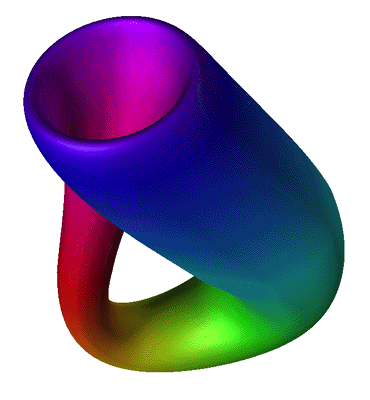 Machine learning is being used extensively in fields like computer vision, natural language processing, and data mining. In many modern applications that are being built, we usually derive a classifier or a model from an extremely large data set. The accuracy of the training algorithms is directly proportional to the amount of data we have. So most modern data sets often consist of a large number of examples, each of which is made up of many features. Having access to a lot of examples is very useful in extracting a good model from the data, but managing a large number of features is usually a burden to our algorithm. The thing is that some of these features may be irrelevant, so it’s important to make sure the final model doesn’t get affected by this. If the feature sets are complex, then our algorithm will be slowed down and it will be very difficult to find the global optimum. Given this situation, a good way to approach it would be to reduce the number of features we have. But if we do that in a careless manner, we might end up losing information. We want to reduce the number of features while retaining the maximum amount of information. Now what does it have to with manifold learning? Why do we care about reducing the dimensionality of our data? Continue reading “What Is Manifold Learning?”
 Perpetual Enigma