 Over the last few decades, we have seen a lot of technologies come by and make a significant impact. Most of these technologies, if you have noticed, revolve around intelligent actions. Let’s say you are in the middle of a street and you want a cab. We can solve this problem in a couple of different ways depending on the level of intelligence we put into our solution. How can we design something that can make use of all the data and provide the best possible solution to the person in the middle of the street? We can say that intelligent action involves search in some way. Searching is needed in a variety of situations, so developing mathematically and computationally strong algorithms is an absolute must. In most of the real life situations, we don’t really know where to look or how a particular search is going to pan out. How do we formulate this? Continue reading “Why Would We Ever Use Blind Search?”
Tag: Artificial Intelligence
What Is Fuzzy Matching?
 This is a continuation of the previous blog post on fuzzy search. We use fuzzy matching algorithms in fuzzy search to come up with the search results. The strength of a fuzzy search algorithm heavily depends on the strength of the fuzzy matching algorithm that is being used. The concept of matching refers to an input being matched to a set of entries, or records, in your database to come up with the best possible match. We encounter this scenario very frequently in our everyday lives. Whenever you are looking up a word in the dictionary or when somebody is looking up your account during a customer service call, some form of matching is being used to get the answers. So how exactly does fuzzy matching work? What’s the big deal here? Continue reading “What Is Fuzzy Matching?”
What Is Fuzzy Search?
 The word “fuzzy” means something that is indistinct or vague, something that cannot be explained precisely. We all know what “search” means. That should give you a hint of what this blog post is about. Whenever you type something into the Google search engine, you will see that it always returns good results, even when you type the wrong spelling. How does it know what you meant? There are many different ways to misspell a word. How does it know exactly what word you have in mind? Continue reading “What Is Fuzzy Search?”
Quantum Computing And Machine Learning
 Quantum Computing refers to the use of quantum mechanical phenomena to make computations. This field is making big strides in the last decade because it can actually help us solve some of the most challenging problems in the realm of computer science, particularly in machine learning and security. Machine learning is all about building better models of the world to make more accurate predictions and security is about safeguarding the things we have built. For example, if we want the machines to see things better, we need better models of how we process visual data. If we want to understand currency fluctuations, we need better models of how they change over time. If we want to create effective environmental policies, we need better models of what’s happening to our climate. So how can we use quantum computing to do these things? Continue reading “Quantum Computing And Machine Learning”
What Is Random Walk?
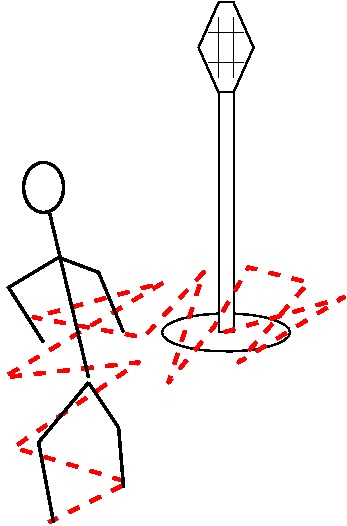 Consider the following situation. We have a drunkard who is clinging to a lamppost, and now he decides to start walking. He is in the middle of the street and the road runs from east to west. In his inebriated state, he is as likely to take a step towards the east as he is towards the west. It just means that there is a 50% chance that he will go in either direction. From each new position, he is again as likely to go east or west. Each of his steps are of the same length but in random direction. After having taken ‘n’ number of steps, he is to be found standing at some position on the street. This is what a random walk is. We can plot the position against the number of steps taken for any particular random walk. Now the question is, can we model his movement so that we can predict where he will be after taking ‘n’ steps? Continue reading “What Is Random Walk?”
What Are Conditional Random Fields?
 This is a continuation of my previous blog post. In that post, we discussed about why we need conditional random fields in the first place. We have graphical models in machine learning that are widely used to solve many different problems. But Conditional Random Fields (CRFs) address a critical problem faced by these graphical models. A popular example for graphical models is Hidden Markov Models (HMMs). HMMs have gained a lot of popularity in recent years due to their robustness and accuracy. They are used in computer vision, speech recognition and other time-series related data analysis. CRFs outperform HMMs in many different tasks. How is that? What are these CRFs and how are they formulated? Continue reading “What Are Conditional Random Fields?”
Why Do We Need Conditional Random Fields?
 This is a two-part discussion. In this blog post, we will discuss the need for conditional random fields. In the next one, we will discuss what exactly they are and how do we use them. The task of assigning labels to a set of observation sequences arises in many fields, including computer vision, bioinformatics, computational linguistics and speech recognition. For example, consider the natural language processing task of labeling the words in a sentence with their corresponding part-of-speech tags. In this task, each word is labeled with a tag indicating its appropriate part of speech, resulting in annotated text. To give another example, consider the task of labeling a video with the mental state of a person based on the observed behavior. You have to analyze the facial expressions of the user and determine if the user is happy, angry, sad etc. We often wish to predict a large number of variables that depend on each other as well as on other observed variables. How to achieve these tasks? What model should we use? Continue reading “Why Do We Need Conditional Random Fields?”
Expectation Maximization
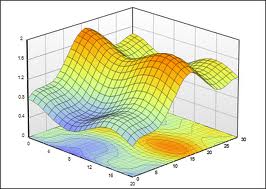 Probabilistic models are commonly used to model various forms of data, including physical, biological, seismic, etc. Much of their popularity can be attributed to the existence of efficient and robust procedures for learning parameters from observations. Often, however, the only data available for training a probabilistic model are incomplete. Missing values can occur which will not be sufficient to get the model. For example, in medical diagnosis, patient histories generally include results from a limited battery of tests. In gene expression clustering, incomplete data arise from the intentional omission of gene-to-cluster assignments in the probabilistic model. If we use regular techniques to estimate the underlying model, then we will get a wrong estimate. What do we do in these situations? Continue reading “Expectation Maximization”
Robot Vs Turing
 In one of my previous blog posts, we discussed about measuring computer’s intelligence and how we can use the Turing test for it. After Turing proposed that test, a lot of people realized its importance and started working on it. People really wanted to believe that machines are indeed capable of thinking. We need a way to determine if a computer is thinking on its own. The biggest obstacle here is that this is a very subjective topic. Given the knowledge that something is indeed a machine, how do we ascertain that the machine is capable of thinking? Continue reading “Robot Vs Turing”
The Genesis Of Genetic Algorithms
 Let’s say you have a function and you want to optimize it. In real life, this function can take many forms like choosing the right set of features for your car while keep the price low, picking the best possible apartment considering all the different factors like location, rent, closeness to stores etc, making a business plan, and many other things. In fact, we continuously use optimization in our everyday life without even realizing it. The interesting thing to note is that we don’t get the most optimal answer every time. We just look around for a while and stop when we get a good enough answer. More often than not, these answers are sub-optimal, mostly depending on the initial point we chose. So how do we get to the best answer? There might be billions of options, do we need check all of them to get to this global optimum? Continue reading “The Genesis Of Genetic Algorithms”
 Perpetual Enigma